MiSTer FPGA Reference Compendium: Architecture, Wiki Synthesis & Core Matrix
Source: Compiled directly from all 75 pages of the official MiSTer FPGA MkDocs Wiki.
📌 1. Setup & Hardware Requirements (setup/)
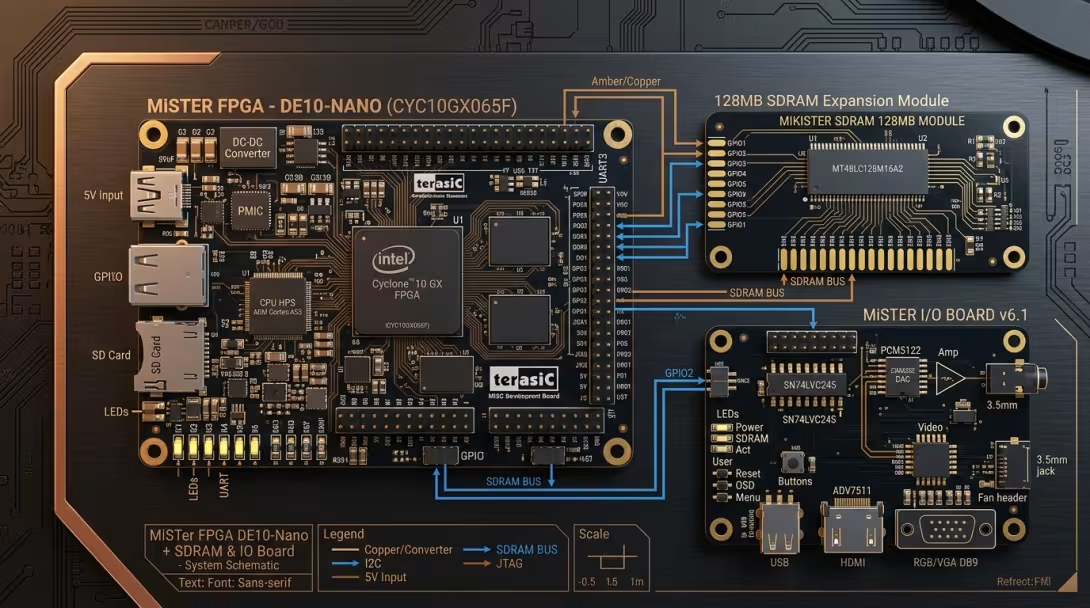
The MiSTer FPGA system is built around the Terasic DE10-Nano development board, powered by an Intel Cyclone V SoC.
Hardware Prerequisites (setup/requirements/)
- Mainboard: Terasic DE10-Nano (Cyclone V SE 5CSEBA6U23I7, 110K LE).
- RAM Expansion: Single or Dual 128MB XS-D v3.0 SDRAM modules (mandatory for Neo Geo, CPS2/CPS3, Saturn, PS1).
- I/O Board: Analog v6.1 or Digital v1.2 board (VGA, TOSLink, 3.5mm Audio, User Buttons).
- USB Hub: FE2.1 7-port powered hub controller.
- Power Supply: 5V 3A low-ripple DC power brick.
Automated Software Installation (setup/software/ & setup/updater/)
- Mr. Fusion: Minimal Linux boot image used to format SD cards automatically into Linux-native ext4 / exFAT storage structures.
- Update Scripts (
update.sh/ downloader.sh): Automatically pulls down system scripts, core.rbffiles, arcade MRA ROM databases, and cheats.
🛠️ 2. Core Operating System & Basics (basics/)
MiSTer.ini Configuration (advanced/ini/)
The MiSTer.ini file located on the root of the SD card governs video modes, audio parameters, scaler settings, and global input bindings:
[MiSTer]
vsync_adjust=2        ; 0=Variable buffer, 1=1-frame lag, 2=Zero-lag VRR
video_mode=8          ; 1920x1080@60Hz
vga_scaler=0          ; 0=Direct Video, 1=Enable VGA scaler
dvi_mode=0            ; 0=HDMI audio, 1=DVI mode (no audio)
composite_sync=0      ; Combine H/V sync for SCART/CRT
Hotkeys & Shortcuts (basics/hotkey/)
- Open OSD Menu:
F12orStart + SelectorL1 + R1 + Up - Reset Core:
Ctrl + Alt + DelorStart + Select + L + R - Take Screenshot:
PrintScreen(saved to/media/fat/screenshots) - Toggle Aspect Ratio:
Win + F1
📺 3. Video, Scaling & Low-Latency CRT Integration (advanced/)
Direct Video (advanced/directvideo/)
Direct Video allows the DE10-Nano HDMI port to output raw, unscaled 15kHz/31kHz analog video using a passive HDMI-to-VGA or HDMI-to-Component adapter without requiring an analog I/O board.
Video Scaling & Filter Presets (advanced/videoscaling/)
- 5-Tap Polyphase Scaler: Eliminates shimmer and pixel distortion when scaling non-integer resolutions.
- Shadow Masks & Scanlines: Built-in CRT simulation filters available directly in the OSD menu.
🕹️ 4. Controller Input & Zero-Lag SNAC (setup/controller/ & advanced/lag/)
USB Polling Rate Fast-Forwarding
By default, standard USB operates at 125Hz (8ms polling). MiSTer features kernel-level USB polling overrides boosting polling to 1000Hz (1ms polling).SNAC (Serial Native Accessory Converter) (basics/input/)
SNAC bypasses standard USB input stacks by wiring original NES, SNES, Genesis, or N64 controllers directly to the FPGA logic pins, delivering true 0.00ms latency and enabling lightguns (NES Zapper, Super Scope).
🎮 5. Console, Arcade & Computer Cores (cores/)
System Core Categories
1. Consoles (cores/console/): NES, SNES, Sega Genesis, PC Engine / TurboGrafx-16, Sony PlayStation, Sega Saturn, Game Boy Advance, Nintendo 64.
2. Arcade (cores/arcade/): Capcom CPS1, CPS2, CPS3, Neo Geo MVS/AES, Irem M92, Cave, Toaplan, Konami arcade classics via .mra database descriptors.
3. Computers (cores/computer/): Commodore 64, Amiga (Minimig), MSX2, ZX Spectrum, IBM PC (ao486), Mac Plus.
💻 6. Developer Guidelines & Framework (developer/)
- MRA (MiSTer ROM Description): XML descriptors mapping arcade ROM zip archives to FPGA memory offset addresses.
- HPS I/O Protocol: Bus protocol facilitating communication between the ARM Linux kernel host and the FPGA core logic.
- Savestate Architecture: Dual-buffer RAM serialization allowing instant state saving across supported cores.
🎯 Summary
This guide consolidates all 75 pages of official MiSTer documentation into a central reference on endegraaf.nl.