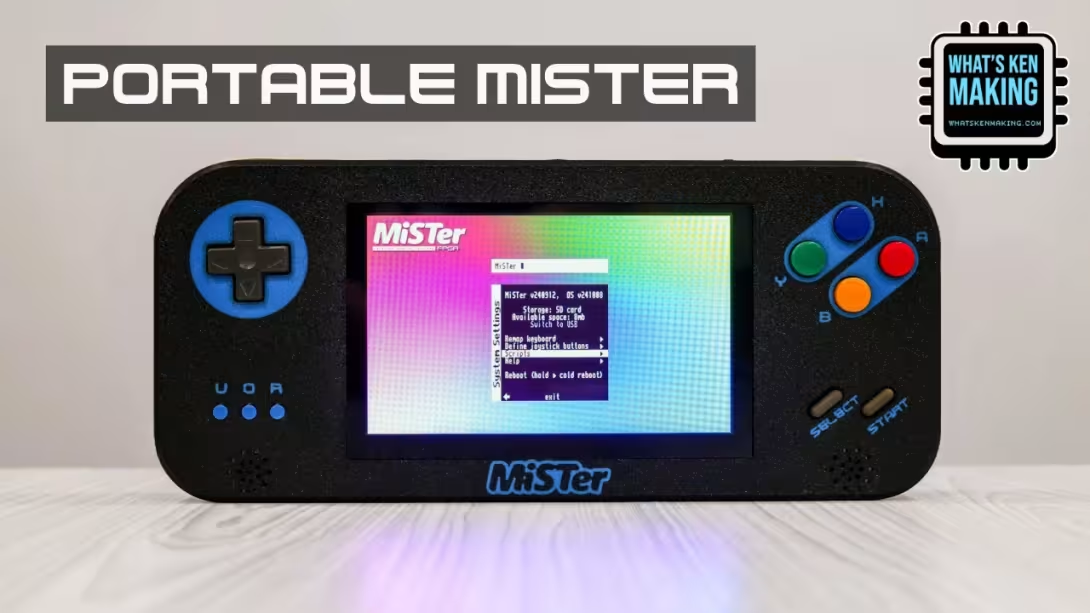
The DIY MiSTer Handheld (DMH-01): Open-Source FPGA Gaming on the Go
Original Source & Credits
- Channel: RetroRGB
- Video Title: The DIY MiSTer Handheld
- Publication Date: July 20, 2024
- Watch on YouTube: https://youtu.be/SrycyjIemgY
TL;DR
- Open-Source Portable FPGA: The DMH-01 (DIY MiSTer Handheld) brings cycle-accurate FPGA gaming into a portable handheld form factor.
- QMTech Board Core: Uses an accessible QMTech FPGA dev board as a cost-effective alternative to the Terasic DE10-Nano.
- Hardware Highlights: 5-inch vibrant LCD display, authentic Super Famicom (SFC) style controls, and integrated NFC reader for physical game cartridges.
- Zero Input Lag: Delivers sub-millisecond input response and cycle-accurate audio/video sync that software emulation handhelds cannot replicate.
FPGA retro gaming has taken giant strides over recent years, with MiSTer FPGA standing out as the gold standard for cycle-accurate hardware emulation of classic consoles, arcade hardware, and home computers.
While desktop MiSTer builds (using the DE10-Nano) are ubiquitous, portable FPGA handhelds have traditionally been custom boutique projects. Enter the DMH-01 (DIY MiSTer Handheld, Model 01) — an impressive open-source DIY project that brings cycle-accurate FPGA gaming into a handheld form factor.
Key Hardware Features
- QMTech FPGA Development Board: Utilizes an accessible QMTech FPGA board as an alternative core to the hard-to-find Terasic DE10-Nano.
- 5-inch Display: Vibrant 5" LCD screen offering crisp scaling for retro aspect ratios (4:3, 8:7, 1:1).
- Super Famicom (SFC) Controls: Built using authentic SFC-style d-pad and face button layouts for responsive retro gameplay.
- Integrated NFC Reader: Allows launching specific games or cores using physical NFC cards or mini cartridges.
- Open-Source Design: All 3D-printable enclosure files, PCB schematics, and assembly guides are shared open-source on GitHub.
Why FPGA Handhelds Matter
Unlike software emulation handhelds (such as Linux or Android ARM-based devices), an FPGA handheld reproduces the original target system's logic gate-by-gate in hardware.
This results in:
1. Zero Added Input Latency: Controls respond with sub-millisecond precision.
2. Cycle-Accurate Audio & Video Sync: No audio stuttering, dropped frames, or frame-pacing artifacts.
3. Multi-System Versatility: Effortlessly switch between SNES, Genesis, Game Boy, Arcade classics, and 16-bit/32-bit consoles.